Text by
movses Tsirani
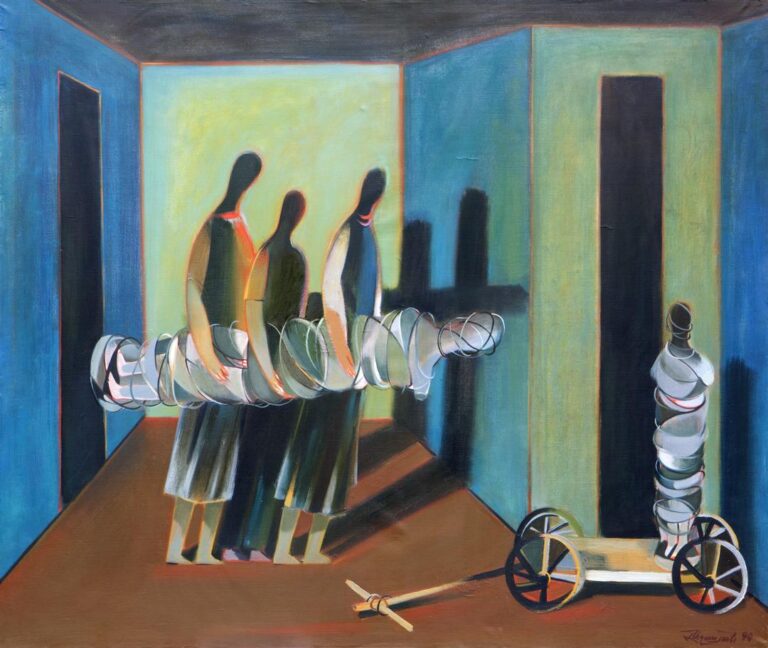
Years ago, time unexpectedly stopped in Armenia. Life changed its course. Even a human felt his nonentity before the fury of nature and unwittingly was pulled into a vortex, where even the body began to suffer, compressed by anxiety of the mind. In the dark of the disaster, even artists turned numb. Under such conditions, the reality seemed unreal for artist L. Aghasyan, while the real appeared to be tangible. He entered a metaphysical realm in search for himself beyond the borders of nature and life – in other places. Places, where tied up bodies wander around abandoned cities, lifeless angels try to fly off the hanging stairways, and in the distance, procreation goes on under the protection of a frozen steed. This troubled artist, on his way of self-identification, enters the world of sub- consciousness, where he tries to find Man with a capital “M”. His aesthetic thinking, although related by blood with some of the surrealists, particularly Giorgio de Chirico, is in such a world that belongs to himself and can lead him much farther.
1996
Lyrical transposition of illustrated themes
As good a designer as he is a colorist, Lavrenti Aghassian is above all concerned with the human presence.
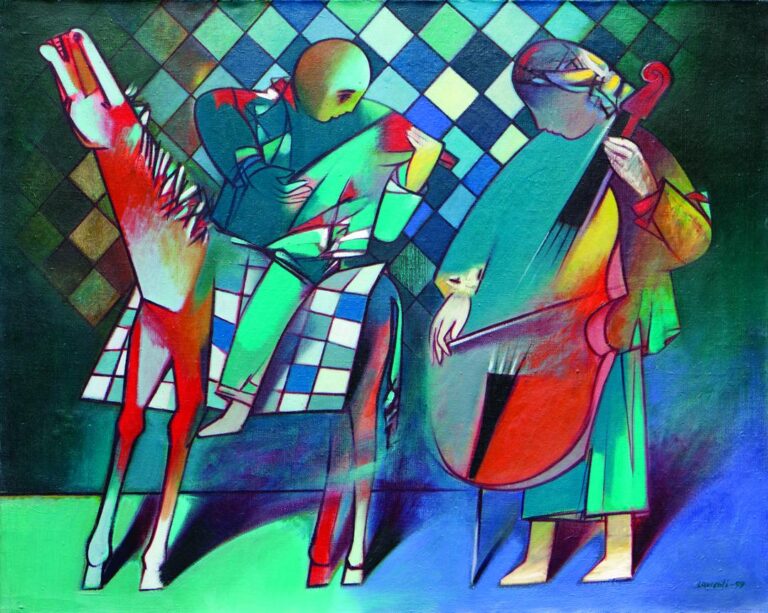
The compositions form a fairly varied whole, in terms of subjects, but retain great unity in technique. If the surface of his works appears flat, he is sensitive to the play of light on the elements, characters, places, interior and exterior spaces, etc., which populate his compositions.
Lavrenti Aghassian’s drawing is clarity itself. Precise, essential, without any dryness, it breathes as well as paint and achieves a difficult synthesis between rigor and sensitivity. The sudden accentuations of the rhythm of the writing, its breaks, its expansions contain a radiant power of very direct effectiveness. It is a writing that is often bursting with intensity, lyricism and light. Although he knows the prestige of color, he nevertheless maintains a concern for form and construction. We do not see in his paintings this clashing and neglected style which translates into the violence of instinct, but relationships of proportions and tones which attest to thoughtful thought and good mastery of the craft. The dominants of his palette are blues, greens, ranges of pinks and grays, velvety or bright reds.
But whatever the importance he gives to technical problems, his taste for serving his ideas leads him, inevitably, to treat in his paintings, subjects having a much more complex meaning than simple places where characters move. The scenes are bathed in a strange light which seems to radiate from within the shapes.
Symbolism is a necessity for him, so that the image not only represents the external world, but also expresses and suggests certain thoughts or ideas consistent with his states of mind. He succeeded in translating, in a purely plastic language, shapes, harmonious colors, subtle contrasts, this poetic universe which is part of his imagination.
If Lavrenti Aghassian’s art has an “obvious” aspect, the meaning of which is sometimes easy to perceive, it also has a fairly “complex” aspect, a delectable poetry and freshness that seduces the viewer.
While recognizing as a basis the necessity of the thing seen, true art, for him, is in the reality felt. His achievements are intended, above all, to acquire a personal language capable of translating his visions. He feels, first of all, the need to observe the elements of reality and it is only, after an effort of will to represent the themes he wants to illustrate, that he is taken as a torment, that to create poetic visions which he translates into tender colored harmonies belonging to a pictorial universe which is never detached from reality.Seeking to reconquer certain values, despite the multiplicity of artistic movements which emerged and succeeded one another from the beginning of the 20th century and the great uproar which set the world of arts in turmoil, Lavrenti Aghassian aspired to a plenary art. He wanted it, as rigorous as academicism, as suggestive as symbolism, as luminous and musical as impressionism, as colorful, contrasting and suggestive as fauvism.
By Nicole MALHAMÉ HARFOUCHE